
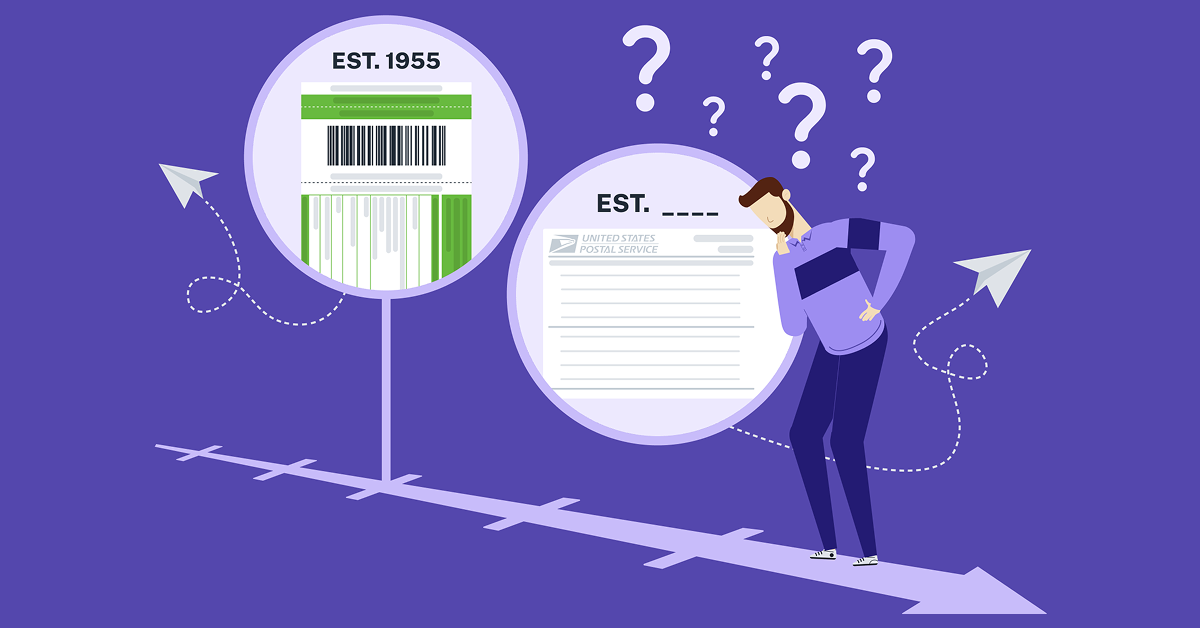
The Certificate of Mailing exists for one reason: to prove something happened on a specific date.
It cannot do this for itself.
I went looking for the day this service started and came back empty. No founding date, no original fee, no statement of purpose. The one service in the entire postal catalog whose whole job is documenting when has no documentation of when.
That gap would be odd for any postal service. It is odd here because this is the only extra service you can buy where evidence is not a feature of the product. Evidence is the entire product. You pay the fee, a clerk round-stamps your form, and that is the whole transaction. No delivery record. No tracking. No insurance. Somebody decided that it was worth charging for, and I would like to know who decided it and when.
The birthday we can actually date
Certified Mail is easy. The Post Office Department launched it on June 6, 1955, and there is a paper trail a mile long. The fee was 15 cents when First-Class postage was 3 cents, so certifying your letter cost 5 times as much as mailing it.
The original POD Form 3800 was a numbered receipt with a gummed stub carrying the same number. You stuck the stamps on yourself, slapped the stub on the address side, and decided for yourself whether a postal employee should postmark your receipt. If you wanted a return receipt, you would handwrite the certified number and your own name and address on a card.
The Post Office even issued a stamp for it, a 15-cent red letter carrier design, the only Certified Mail stamp ever issued. A stamp columnist predicted in July 1955 that the stamp, not the service, would be discontinued within a year as unnecessary. He was right, which is a rare thing in this industry and worth noting.
The Postmaster General pitched the service as giving mail patrons most of the advantages of registered mail at lower cost and with less trouble. Seventy-one years later, the green card still asks you to handwrite your own address on a card. Some traditions are load-bearing.
The birthday that nobody can find
Now try the same exercise with the Certificate of Mailing.
I searched USPS historian material, Postal Explorer, PostalPro, the Postal Bulletin archive, and published postal history. I can tell you exactly what the service does today, down to the section number. I cannot tell you when it started, what it originally cost, or what the Post Office Department said it was for.
That gap is worth noticing. A service that a meaningful share of the insurance industry relies on every day to prove it mailed a cancellation notice, and it has never been given a founding date in public. Certified Mail gets a stamp and a listing in the historian’s “On This Day” file. Certificate of Mailing gets nothing. No cake, no candles, no card.
That seems like an oversight worth correcting, and it is fixable.
The insurance industry deserves more credit, not less
Somebody in the industry told me recently that insurance carriers created the Certificate of Mailing because they needed a way to prove they mailed a cancellation notice. I went looking for the record behind that, partly out of curiosity and partly because I wanted to cite it.
I could not confirm it, and I could not rule it out either. The founding record simply is not public. So I want to be careful here, because the instinct behind that story is right even if the paperwork to prove it is still sitting in an archive somewhere.
Here is what I can document, and I think it is a bigger claim than the one I was told.
State legislatures wrote this service into law by name. Not a general reference to proof of mailing. The actual words “certificate of mailing,” sitting in a state code, as the thing a carrier must obtain. One state went further and specified which version does not count. Whatever happened at the creation, the insurance industry is why this service carries legal weight today, and that is a greater contribution than inventing a form.
Certificate of Mailing may be the only USPS extra service whose commercial life is defined by statutory language rather than by mailer preference. Senders buy Certified Mail because they want proof. Carriers buy a Certificate of Mailing because a legislature typed the words “certificate of mailing” into the code, and that language exists because the insurance industry needed the standard to be exact.
What the service actually is, per the people who run it
The Domestic Mail Manual is refreshingly blunt here. A certificate of mailing service may be presented only at the time of mailing. It provides evidence that individual mailpieces were presented to the Postal Service. It does not provide a record of delivery. The fee does not provide any insurance against loss or damage. USPS rounds-dates the form at the time of mailing and hands it back to you.
And then the part that should keep a compliance officer up at night: the Postal Service does not retain copies.
Your stamped form is not the best copy of the evidence. It is the only copy. No backup in a postal database, no clerk’s ledger in a back room, no two-year window as the one Certified Mail scans get. If the round stamp is missed, the sheet is lost, or the file is purged under a retention schedule shorter than the statute of limitations, the mailing did not happen, as far as anyone can prove. You are not the custodian of a copy. You are the custodian of the copy.
The forms
Four forms get mixed up constantly, including by people who mail them every single day. This includes PS Form 3817, 3665, 3606-D, and 3877. For a full review of each of these forms and their differences, check out Certified Mail vs. Certificate of Mailing: What’s the Difference?
The line between PS Form 3665 and PS Form 3606-D is what decides cases. A 3606-D proves that a quantity of identical pieces entered the mail. It does not prove that a notice went to a named insured at a specific address. When a carrier is defending a cancellation, the count is worth roughly nothing. The itemized list is worth everything.
The part that shapes the economics
This one is easy to miss because the physical act at the counter looks identical either way.
When you list Certified Mail on a PS Form 3877 firm mailing book and hand it across the counter, the proof of mailing costs you nothing extra. You already bought it. It is included in the Certified Mail fee, along with the delivery record and the retained scan data.
When you list pieces on a PS Form 3665 or submit a PS Form 3606-D, you pay a fee to do it. Same counter, same clerk, same round stamp, different invoice. That fee does not include delivery, tracking, or insurance. It is buying evidence, and nothing else. Ask for duplicate copies, and you pay again.
The two forms are not interchangeable, either. That is exactly what the June 2, 2017 conversion deadline settled: mailers running approved PS Form 3877 facsimiles in place of PS Form 3665 had to move to the real thing.
The purchase you are actually making
Certified Mail sells you a delivery record, and the proof of mailing rides along at no additional charge. Certificate of Mailing sells you the round stamp and nothing more. That is why the line item looks strange the first time it shows up on an invoice, and why it is worth every cent the first time somebody disputes whether a notice went out.
I am deliberately not printing the fees here. Rates change; this article will not, and you can pull the current figures from Notice 123 faster than I can keep a blog post honest.
Where insurance actually enters the story
Here is the documented linkage, and it is the part worth building an argument on. State codes name the service directly, and at least one of them excludes the bulk variant by name, which tells you a legislature was paying close attention.
| Jurisdiction | Citation | What it says |
|---|---|---|
| New York | N.Y. Veh. & Traf. Law section 313(1)(a) | Notice of termination of an owner’s liability policy must be sent by regular mail with a certificate of mailing properly endorsed by the postal service |
| New York | N.Y. Ins. Law section 3425(h)(1) | Proof of mailing of a cancellation notice to the named insured at the address shown in the policy is sufficient proof of the giving of notice |
| Virginia | Va. Code section 38.2-2113 | Allows proof of mailing by certificate of mailing obtained from USPS at the time the notice is accepted, states expressly that a certificate of mailing does not include a certificate of bulk mailing, and requires the proof to be retained for one year from the effective date |
Notice what none of these require
None of them require the carrier to prove the insured actually received the notice. They require proof that the notice was mailed on a date to the address in the policy. That is a proof-of-mailing standard, and Certificate of Mailing is the cheapest postal instrument that hits it exactly.
This is also why the service sailed through the digital era without a scratch. The mail that could leave, left. Statements went electronic. Invoices went electronic. A notice whose legal sufficiency rests on a round-dated postal receipt is not going anywhere, because the statute is not written in a language email speaks.
Where the line moves
Proof of proper mailing raises a presumption that the addressee received the notice, and the statutes above codify that presumption for insurance notices. Constitutional due process for adverse government action sets a higher bar, as the Supreme Court drew in Jones v. Flowers, 547 U.S. 220 (2006), addressing what a state must do once it learns that a mailed notice was returned undelivered. Knowing which side of that line your notice program sits on is the difference between Certificate of Mailing being sufficient and Certified Mail being required.
What has actually changed, and when
The service itself has barely moved. The acceptance mechanics around it have, and unlike the origin story, all been documented with dates.
| Effective | What Changed | Where it was published |
|---|---|---|
| January 17, 2016 | DMM Part 503 revised with new standards for domestic Certificates of Mailing, centralizing USPS approval of facsimile forms, and clarifying facsimile standards | Postal Bulletin 22431, December 24, 2015 |
| June 2, 2017 | Conversion deadline for mailers using approved PS Form 3877 facsimiles in place of PS Form 3665, and PS Form 3606 facsimiles in place of PS Form 3606-D | Postal Bulletin 22431, December 24, 2015 |
| January 19, 2025 | DMM 503.5.1.6 and 503.5.2.3 revised so that electronically submitted PS Form 3665 with three or more pieces, and electronically submitted PS Form 3606-D of any quantity or weight, may be presented at a Post Office BMEU | Postal Bulletin 22664, November 28, 2024 |
Certificates of Mailing can now be submitted electronically through Postal Wizard or Mail.dat with a Business Customer Gateway account. That is the quiet headline nobody put on a banner. A service whose defining artifact was a physically round-stamped piece of paper now has a documented electronic path.
If you generate tens of thousands of firm sheets a year, that is not an efficiency story. It is a risk story. Every physical round stamp is a manual step that can be skipped, and a skipped stamp does not announce itself on the day of mailing. It shows up years later, in a coverage dispute, when somebody asks to see the proof and the sheet has a blank spot where the stamp should be.
Help me find the birthday
Here is my open ask, and I mean it sincerely.
The USPS historian maintains the Annual Report of the Postmaster General going back to 1789, Postal Laws and Regulations going back to 1794, the United States Official Postal Guide from 1874 to 1954, and the Postal Bulletin since 1880. The collection is open to the public by appointment, and the historian’s staff can help with research into specific corners of postal history.
Three questions would close this out:
- In which edition of Postal Laws and Regulations does the certificate of mailing service, or a predecessor under any other name, first appear, and what was the original fee?
- What did the Post Office Department say the service was for at the time it was introduced, whether in the Annual Report of the Postmaster General or the Postal Bulletin?
- When did the firm sheet variant, the ancestor of today’s PS Form 3665, first appear, and does the record show which mailer segments pushed for it?
If the answer to question three names insurance carriers, then the person who told me the origin story was right, and I will say so in print with the citation attached. If it does not, the record still shows a general-purpose postal receipt that one industry adopted so thoroughly and wrote into law so precisely that everyone assumes the industry built it. Both endings are good ones.
Either way, somebody owes this service a cake.
What to do with all this
- Match the instrument to the statute, not to habit. If the statute requires proof that a notice was mailed, a Certificate of Mailing satisfies it. If the statute or the business risk requires evidence of delivery or an attempted delivery, it does not, and no amount of process discipline will change that.
- Respect the bulk carve-out. Virginia’s code states that a certificate of mailing does not include a certificate of bulk mailing. Any notice program that leans on a PS Form 3606-D count instead of an itemized PS Form 3665 is building its defense on a form the statute already ruled out.
- Treat the receipt as the system of record, because it is. USPS keeps nothing. Whatever holds those round-dated forms, a file cabinet or a database, is the entire evidentiary chain, and its retention schedule should match the longest statute of limitations you could face rather than the one-year floor some codes specify.
One caution before you quote a market number
Certificate of Mailing is not broken out in the USPS Revenue, Pieces, and Weight filings. It sits inside Other Domestic Ancillary Services. That means every published Certificate of Mailing volume or revenue figure you will ever see, including mine, is a model rather than a USPS number. Ask anyone who quotes you one to show the derivation.
Solving the paper trail problem
So you have just read a few thousand words about a service with no known birthday, whose defining artifact is a piece of paper the Postal Service refuses to keep a copy of. Sounds like a system that would prefer to stay exactly where it is.
Easy Send, the digital platform from Digitalized Software, Inc. for Certified Mail and Certificate of Mailing, replaces the clerk-stamped, paper-only, lose-it-and-it-is-gone process with a digital proof of mailing. Every mailpiece, every date, every recipient, captured and retained digitally for 11 years, against the zero years USPS keeps your paper forms, and the two years it keeps Certified Mail scans.
Automated COM today covers PS Form 3665, PS Form 3606-D, and PS Form 3877, and the physical firm book is still produced in the background for the purists and the appropriately paranoid. The COM ID identifies the manifest electronically, the BMEU clerk validates it, and the digital round-date stamp posts the same business day.
We may never find the birthday. We can at least stop celebrating it with a filing cabinet.
About Mike Bogad
Mike Bogad brings 30 years of experience in critical business document automation as Vice President of Business Development and Partnerships at Digitalized Software. He focuses on strategic growth, building partnerships, and delivering customer-centric software solutions. Mike is committed to revolutionizing manual processes with cutting-edge technology, from Digitalized Software to industry leadership.